
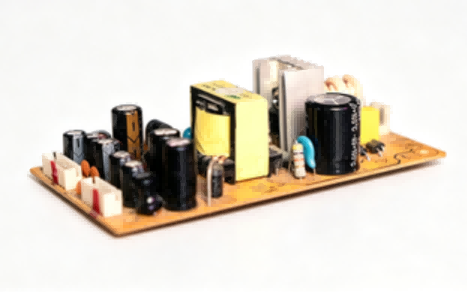
Practical Methods to Improve Standby Efficiency of Switching Power Supplies
From lianglite • Electronics Classroom
Standby efficiency of switching power supplies directly affects energy consumption and product performance. lianglite has summarized 4 highly practical optimization methods to help achieve lower power loss and higher efficiency in standby and light-load conditions.
1. Cut Off the Startup Resistor
In flyback power supplies, after startup, the control IC is powered by the auxiliary winding, but the startup resistor still sustains a voltage drop of nearly 300V. Taking a 47kΩ startup resistor as an example, the power loss is close to 2W.
Improvement methods:
- Use ICs with built-in startup shutdown circuits (e.g., TOPSwitch, ICE2DS02G) to automatically disconnect the startup resistor path after startup.
- If no dedicated circuit is available, connect a capacitor in series to reduce standby loss to zero. The drawback is that the system can only restart after the capacitor is fully discharged.
2. Reduce the Switching Frequency
Reduce the system operating frequency in standby or light-load mode through smooth or step-down frequency control, which directly reduces switching loss.
When the feedback signal exceeds a set threshold, a dedicated module linearly lowers the frequency to reduce standby power consumption without affecting control stability.
3. Switch Operating Modes
QR → PWM Mode Switching
Quasi-resonant (QR) power supplies typically operate at hundreds of kHz to several MHz. Switching to low-frequency PWM mode (tens of kHz) in standby greatly reduces loss.
Typical ICs: IRIS40xx series. When the resonant signal cannot be triggered under light load/standby, the system automatically enters low-frequency PWM operation.
PWM → PFM Mode Switching
Conventional PWM power supplies switch to PFM mode at light load: fixed on-time, adjustable off-time. The lighter the load, the longer the off-time and the lower the operating frequency.
Mode switching is controlled via the PW/ pin level, enabling high-efficiency operation across the full load range with fast response to load transients.
4. Burst Mode / Skip-Cycle Mode
Under light load or standby, a large-period signal controls PWM pulses to be enabled or disabled, reducing switching times and increasing effective duty cycle to minimize standby loss.
Skip-cycle control can be implemented:
- in the feedback loop
- at the PWM output
- via chip enable pins (e.g., LM2618, L6565)
- or internal modules (NCP1200, FSD200, TinySwitch series)
lianglite specializes in circuit protection and power supply efficiency optimization.