
One - stop services
Spanning from electronic DESIGN to the SALE of electronic components.
Menu
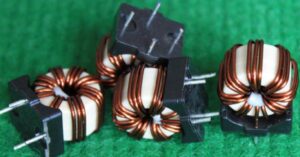
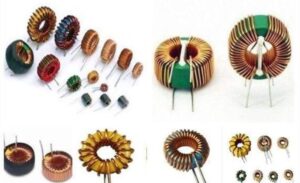
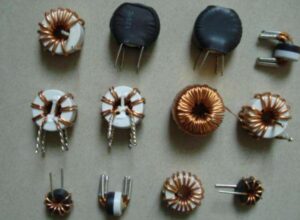
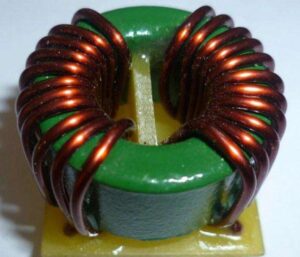
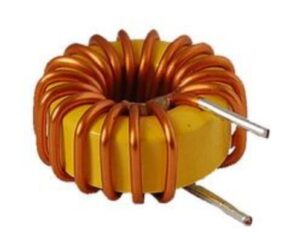
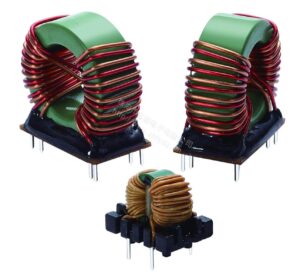
Toroidal Inductor
A toroidal inductor consists of a ring-shaped magnetic core.
It is a commonly used anti-interference component in electronic circuits and provides excellent suppression of high-frequency noise.
It is a commonly used anti-interference component in electronic circuits and provides excellent suppression of high-frequency noise.
As a widely used interference suppression device in circuits with good performance against high-frequency noise, toroidal inductors are generally made of ferrite material (Mn-Zn). Toroids exhibit different impedance characteristics at different frequencies: impedance is very low at low frequencies, but rises sharply as the signal frequency increases. As we know, higher signal frequencies are more prone to radiation (hence high-quality computer cases are used to reduce electromagnetic leakage). Since ordinary signal lines usually have no shielding layer, they act as effective antennas, picking up various stray high-frequency signals from the surrounding environment. These unwanted signals superimpose on the original transmitted signal and may even distort the useful signal. With a toroidal inductor, normal useful signals can pass smoothly while high-frequency interference is effectively suppressed — all at low cost.
Passing an entire cable bundle through a ferrite toroid forms a common-mode choke. If needed, the cable can also be wound several turns around the toroid. More turns improve suppression of lower-frequency interference but reduce effectiveness against higher-frequency noise. In practical engineering, the number of turns is adjusted according to the frequency characteristics of the interference current. When the interference signal has a wide frequency band, two toroids with different turn counts are often used on the same cable to suppress both high-frequency and low-frequency interference simultaneously.
From the working principle of common-mode chokes, higher impedance leads to better interference suppression. The impedance of a common-mode choke comes from its common-mode inductance Lcm=jωLcm. From this formula, for a given noise frequency, larger inductance of the toroid is better. However, this is not entirely true in practice because real toroids have parasitic capacitance in parallel with the inductance. At high interference frequencies, the capacitive reactance becomes very low and short-circuits the inductance of the toroid, causing the common-mode choke to lose its effectiveness.