
One - stop services
Spanning from electronic DESIGN to the SALE of electronic components.
Menu
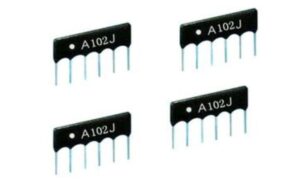
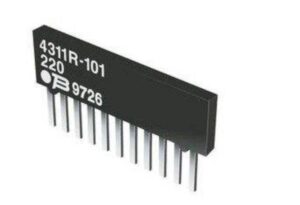
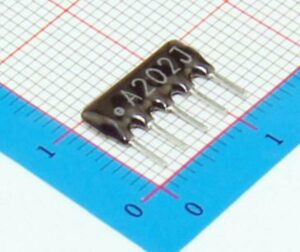
Through-hole Resistor Array
Network Resistor, also called resistor array, is an assembly of several resistors with identical parameters packaged together.
One pin of each resistor is connected together as a common pin, while the other pins are led out normally.
Therefore, a network resistor composed of n resistors has n+1 pins.
Generally, the leftmost pin is the common one, usually marked with a colored dot.
One pin of each resistor is connected together as a common pin, while the other pins are led out normally.
Therefore, a network resistor composed of n resistors has n+1 pins.
Generally, the leftmost pin is the common one, usually marked with a colored dot.
Functions of Network Resistors
- Integrates multiple individual resistors; internal connections can be series or parallel.
- Simplifies PCB layout, eases installation, ensures high-quality SMT soldering, and reduces equipment volume.
Impedance Matching
- Advantage: After impedance matching, there is almost no effect on the current-stage signal.
- Relationship: Impedance is the vector sum of resistance and reactance.
- Matching between load impedance and source internal resistance
- Matching between load impedance and transmission line impedance
- Matching between load impedance and signal source internal resistance
- Satisfies impedance matching requirements in high-frequency circuits
Matching Terms
- Load impedance equals signal source internal resistance (same magnitude and phase angle), enabling undistorted voltage transmission.
- Load impedance equals the complex conjugate of signal source internal resistance (same magnitude, sum of phase angles = 0), achieving maximum power transfer — known as conjugate matching.
- If both source and load are purely resistive, the two matching conditions are equivalent.
Features
Network resistors are directional. Compared with color-ring resistors, they are neat and space-saving.
Pin Description
In a typical network resistor, resistance between pin 1–a, 2–b, 3–c, 4–d is all 10 Ω, independent of other pins. It is simply a row of resistors integrated into one component.
Some types have a common pin. Measured with a multimeter:
- Resistance from any pin to the common pin equals the rated value.
- Resistance between any two non-common pins is twice the rated value, as they are connected in series through the common pin.
They are especially convenient for applications requiring many pull-up or pull-down resistors, such as parallel communication lines, while saving space.