
One - stop services
Spanning from electronic DESIGN to the SALE of electronic components.
Menu
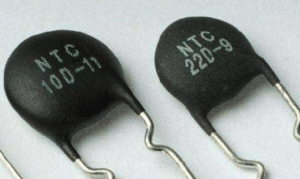
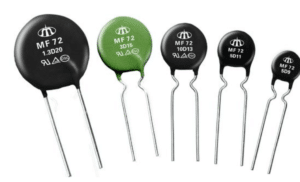
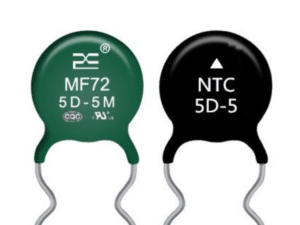
Thermistor
Thermistors are a type of sensitive component, which are divided into Positive Temperature Coefficient (PTC) thermistors and Negative Temperature Coefficient (NTC) thermistors according to different temperature coefficients. A typical characteristic of thermistors is their sensitivity to temperature, showing different resistance values at different temperatures. The resistance value of Positive Temperature Coefficient (PTC) thermistors increases with the increase of temperature, while the resistance value of Negative Temperature Coefficient (NTC) thermistors decreases with the increase of temperature. Both of them belong to semiconductor devices.
The main characteristics of thermistors are:
① High sensitivity: its temperature coefficient of resistance is 10 to 100 times higher than that of metals, and it can detect temperature changes of 10⁻⁶℃;
② Wide operating temperature range: normal temperature devices are suitable for -55℃~315℃, high temperature devices are suitable for temperatures above 315℃ (the highest can reach 2000℃ at present), and low temperature devices are suitable for -273℃~-55℃;
③ Small size: it can measure the temperature of gaps, cavities and blood vessels in organisms that cannot be measured by other thermometers;
④ Easy to use: the resistance value can be arbitrarily selected between 0.1~100kΩ;
⑤ Easy to process into complex shapes and suitable for mass production;
⑥ Good stability and strong overload capacity.
The thermistor will be in a non-operating state for a long time; when the ambient temperature and current are in zone c, the heat dissipation power of the thermistor is close to the heat generation power, so it may or may not operate. When the ambient temperature is the same, the operating time of the thermistor decreases sharply with the increase of current; when the ambient temperature is relatively high, the thermistor has a shorter operating time, smaller holding current and operating current.
1. PTC effect: A material has PTC (Positive Temperature Coefficient) effect, that is, positive temperature coefficient effect, which only means that the resistance of this material will increase with the increase of temperature. For example, most metal materials have PTC effect. In these materials, the PTC effect is manifested as a linear increase in resistance with temperature, which is usually called linear PTC effect.
2. Non-linear PTC effect: Materials that have undergone phase transition will show a phenomenon that the resistance increases sharply by several to more than a dozen orders of magnitude within a narrow temperature range, that is, non-linear PTC effect. Quite a variety of conductive polymers will show this effect, such as polymer PTC thermistors. These conductive polymers are very useful for manufacturing overcurrent protection devices.
3. Polymer PTC thermistors for overcurrent protection: Polymer PTC thermistors are often referred to as self-resetting fuses (hereinafter referred to as thermistors). Due to their unique positive temperature coefficient resistance characteristics, they are very suitable for use as overcurrent protection devices. The thermistor is used in series in the circuit, just like an ordinary fuse.
When the circuit works normally, the temperature of the thermistor is close to room temperature and its resistance is very small, so it will not hinder the current passing through when connected in series in the circuit; when the circuit has overcurrent due to failure, the temperature of the thermistor rises due to the increase of heat generation power. When the temperature exceeds the switching temperature, the resistance increases sharply in an instant, and the current in the circuit quickly decreases to a safe value. It is a schematic diagram of the current change during the protection of the AC circuit by the thermistor. After the thermistor operates, the current in the circuit is greatly reduced, and t in the figure is the operating time of the thermistor. Due to the good designability of polymer PTC thermistors, their sensitivity to temperature can be adjusted by changing their own switching temperature (ts), so they can play both over-temperature protection and over-current protection roles. For example, the KT16-1700DL thermistor is suitable for over-current and over-temperature protection of lithium-ion batteries and nickel-metal hydride batteries because of its low operating temperature. The influence of ambient temperature on polymer PTC thermistors: Polymer PTC thermistors are direct-heating, step-type thermistors, and their resistance change process is related to their own heat generation and heat dissipation, so their holding current (ihold), operating current (itrip) and operating time are affected by ambient temperature. When the ambient temperature and current are in zone a, the heat generation power of the thermistor is greater than the heat dissipation power and it will operate; when the ambient temperature and current are in zone b, the heat generation power is less than the heat dissipation power. Due to the recoverable resistance of the polymer PTC thermistor, it can be used repeatedly. Figure 6 is a schematic diagram of the resistance change with time during the recovery process after the thermistor operates. The resistance can generally recover to about 1.6 times the initial value within ten to dozens of seconds. At this time, the holding current of the thermistor has recovered to the rated value and can be used again. Thermistors with smaller area and thickness recover relatively faster; while thermistors with larger area and thickness recover relatively slower.