
One - stop services
Spanning from electronic DESIGN to the SALE of electronic components.
Menu
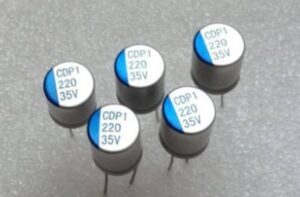
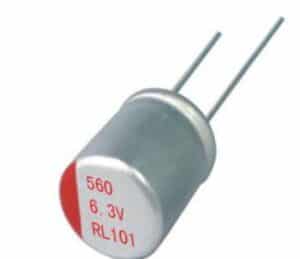
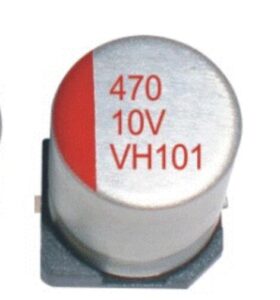
Solid Capacitor
Solid-state capacitors are fully named solid aluminum electrolytic capacitors.
The biggest difference from ordinary (liquid aluminum electrolytic) capacitors lies in the dielectric material: liquid capacitors use electrolyte, while solid-state capacitors use conductive polymer materials.
The biggest difference from ordinary (liquid aluminum electrolytic) capacitors lies in the dielectric material: liquid capacitors use electrolyte, while solid-state capacitors use conductive polymer materials.
Solid aluminum polymer chip capacitors feature a unique structure combining the characteristics of aluminum electrolytic and tantalum capacitors. Like liquid aluminum electrolytic capacitors, they are mostly packaged in surface-mount (SMD) form. A highly conductive polymer electrode film is deposited on aluminum oxide as the cathode, with carbon and silver as cathode terminals — similar to the structure of solid tantalum electrolytic capacitors.
1. High Stability
Solid aluminum electrolytic capacitors operate stably under high temperatures, directly improving motherboard performance. With stable impedance over a wide temperature range, they are ideal for power filtering, providing steady and sufficient power — especially critical for overclocking.
They maintain normal electrical performance at high temperatures. Capacitance variation is within ±15% across the full temperature range, significantly better than liquid electrolytic capacitors. Additionally, their capacitance is nearly independent of operating voltage, ensuring stable performance under voltage fluctuations.
2. Long Lifespan
Solid aluminum electrolytic capacitors offer an extremely long service life (exceeding 50 years). Unlike liquid types, they do not suffer breakdown, electrolyte drying, or leakage that could harm motherboard stability. Free from liquid electrolyte issues, they make circuits more reliable.
Solid electrolyte does not evaporate, expand, or burn at high temperatures. Even if temperature exceeds limits, the polymer only melts without causing casing rupture, ensuring high safety. Lifespan is far longer than liquid capacitors at all operating temperatures.
3. Low ESR and High Rated Ripple Current
ESR (Equivalent Series Resistance) is a critical capacitor parameter. Lower ESR enables faster charging/discharging, improving decoupling in CPU power circuits. This advantage becomes especially prominent in high-frequency applications — low ESR at high frequencies is the key distinction between solid and liquid capacitors.
Solid aluminum capacitors have very low ESR and minimal energy dissipation. Under high-temperature, high-frequency, high-power conditions, their ultra-low ESR effectively absorbs high-amplitude voltage spikes on power lines, preventing system interference.
Modern CPUs have extremely high power consumption, with frequencies far above 1 GHz and peak currents up to 80 A or more, pushing output filter capacitors to their limits. CPUs also frequently switch operating modes. When transitioning from low-power to full-load mode (typically within 5 ms), the large instantaneous energy demand is supplied by power circuit capacitors. The high-speed charge-discharge characteristic of solid-state capacitors delivers peak current instantly, ensuring stable CPU operation.