
One - stop services
Spanning from electronic DESIGN to the SALE of electronic components.
Menu
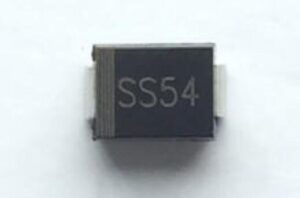
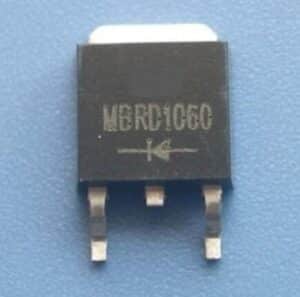
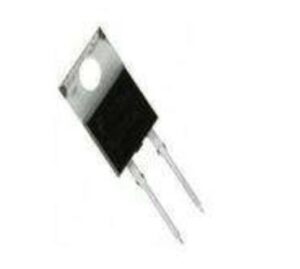
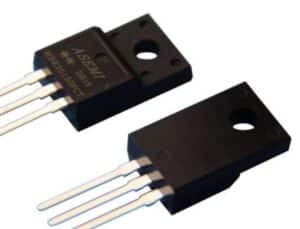
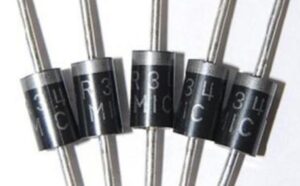
Schottky Diode
The Schottky diode is named after its inventor, Dr. Schottky.SBD is the abbreviation for Schottky Barrier Diode.Instead of using the PN junction formed by the contact of P-type and N-type semiconductors, the SBD is manufactured based on the metal-semiconductor junction formed by metal-semiconductor contact.Therefore, the SBD is also known as a metal-semiconductor (contact) diode or surface barrier diode, which is a type of hot-carrier diode.
The main advantages of SBD are as follows:
- Since the Schottky barrier height is lower than that of a PN junction, its forward conduction threshold voltage and forward voltage drop are both lower than those of PN junction diodes (about 0.2V lower).
- Since the SBD is a majority-carrier conduction device, there are no issues with minority-carrier lifetime or reverse recovery.The reverse recovery time of the SBD is only the charging and discharging time of the Schottky barrier capacitance, which is completely different from that of PN junction diodes.Due to the very low reverse recovery charge of the SBD, it features an extremely fast switching speed and particularly low switching loss, making it especially suitable for high-frequency applications.
However, because the reverse barrier of the SBD is relatively thin and breakdown easily occurs on its surface, its reverse breakdown voltage is relatively low. Since the SBD is more prone to thermal breakdown than PN junction diodes, its reverse leakage current is larger than that of PN junction diodes.
The Schottky diode, also known as Schottky Barrier Diode (SBD for short), is a low-power, ultra-high-speed semiconductor device. Its most prominent features are an extremely short reverse recovery time (as low as a few nanoseconds) and a forward voltage drop of only about 0.4V. It is widely used as a high-frequency, low-voltage, high-current rectifier diode, freewheeling diode, and protection diode. It is also applied in microwave communication circuits as a rectifier diode and small-signal detector diode, and is commonly used in communication power supplies, frequency converters, and other equipment.
A typical application is in the switching circuits of bipolar junction transistors (BJTs). By connecting a Schottky diode across a BJT for clamping, the transistor is kept close to the cut-off state even when conducting, thereby improving the switching speed of the transistor. This method is used in the internal TTL circuits of typical digital ICs such as 74LS, 74ALS, and 74AS series.
The most significant feature of the Schottky diode is its relatively low forward voltage drop VF. Under the same current, its forward voltage drop is much smaller. In addition, it has a short recovery time. It also has some disadvantages: relatively low voltage withstand capability and slightly larger leakage current. Comprehensive consideration is required during selection.