
One - stop services
Spanning from electronic DESIGN to the SALE of electronic components.
Menu
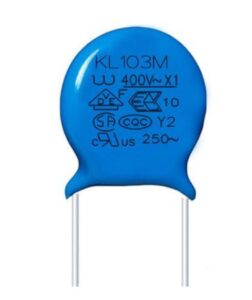
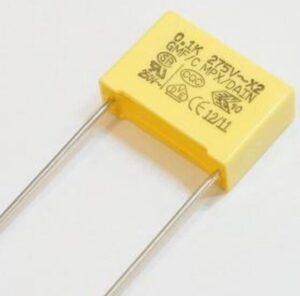
Safety Capacitor
Safety capacitors are safety-certified capacitors that will not cause electric shock or endanger personal safety even if they fail.They are typically used for filtering in anti-interference circuits.
Applied in power supply filters, they suppress common-mode and differential-mode interference respectively.
Safety capacitors are classified into Class X and Class Y. AC power input has three terminals: Live (L), Neutral (N), and Ground (G).
- Capacitors connected between L–N (Live–Neutral) are X capacitors.
- Capacitors connected between L–G or N–G (Live–Ground or Neutral–Ground) are Y capacitors.
The names X and Y come from their connection shapes, not from dielectric materials.
X Capacitor
X capacitors are also safety capacitors and must comply with relevant safety standards. Their capacitance can be larger than that of Y capacitors, but a safety resistor must be connected in parallel at both ends to prevent the power plug from remaining charged for a long time due to capacitor charging/discharging when unplugged. Safety standards require that within 2 seconds after unplugging a working device, the voltage across the power plug must drop below 30% of its rated working voltage.
X capacitors must be certified by safety authorities. They are usually marked with safety logos and rated for AC250V or AC275V, but their actual DC withstand voltage exceeds 2000V. Ordinary capacitors rated AC250V or DC400V must not be used as substitutes.
X capacitors are usually polyester film types with high ripple current capability. They are relatively large in size but support high instantaneous charge/discharge current and have low internal resistance.
Y Capacitor
Y capacitors are connected in critical positions and must meet strict safety standards to avoid leakage current or charged chassis that could endanger safety. Their capacitance must be small, while withstand voltage must be high.
- Devices used in subtropical regions: leakage current to ground ≤ 0.7 mA
- Devices used in temperate regions: leakage current to ground ≤ 0.35 mA
Therefore, the total capacitance of Y capacitors generally does not exceed 4700 pF (472). Capacitance is limited to control leakage current and EMC performance. GJB151 specifies that Y capacitor capacitance shall not exceed 0.1 μF.
Besides withstanding grid voltage, Y capacitors must have sufficient safety margins electrically and mechanically to avoid breakdown or short-circuit under extreme conditions. Their voltage withstand capability is critical for personal safety.
Y capacitors must also be safety-certified. They are usually orange or blue, marked with safety logos (UL, CSA, etc.) and rated AC250V or AC275V, but their actual DC withstand voltage exceeds 5000V. Ordinary capacitors rated AC250V or DC400V must NOT be used as replacements.