
One - stop services
Spanning from electronic DESIGN to the SALE of electronic components.
Menu
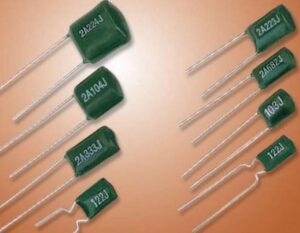
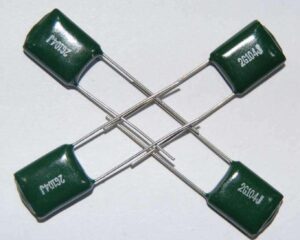
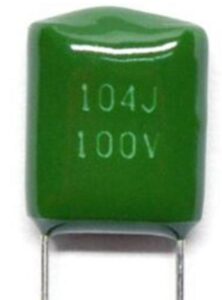
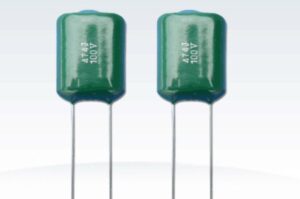
Polyester Capacitor
A polyester capacitor uses two pieces of metal foil as electrodes, sandwiched in an extremely thin insulating medium and wound into a cylindrical or flat cylindrical core. The dielectric is polyester film.
Polyester capacitors feature high dielectric constant, small size, large capacitance and good stability, making them suitable for use as bypass capacitors.
Polyester capacitors feature high dielectric constant, small size, large capacitance and good stability, making them suitable for use as bypass capacitors.
Outstanding advantages: Accuracy, dissipation factor, insulation resistance, temperature characteristics, reliability and environmental adaptability of polyester film capacitors are all superior to electrolytic capacitors and ceramic disc capacitors.
Outstanding disadvantages: Both capacitance-to-price ratio and capacitance-to-volume ratio are worse than the above two types of capacitors.
Applications: Used in various DC or medium-low frequency pulsating circuits, especially suitable as bypass capacitors.
Capacitance range: 470pF ~ 4.7μF Rated voltage range: 63–630V Dissipation factor: 0.3–0.7 Operating temperature: -55℃ to 125℃ Temperature coefficient: +200 ~ +600ppm
Common classifications: Like many capacitors, polyester capacitors have detailed subtypes, such as common CL11 and CL21. The difference is that CL21 capacitors adopt metallization technology on the inner wall, resulting in much smaller size than CL11, but overall performance is inferior to CL11.