
One - stop services
Spanning from electronic DESIGN to the SALE of electronic components.
Menu
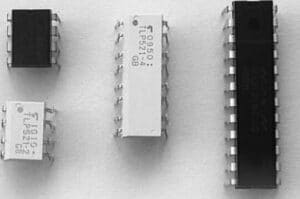
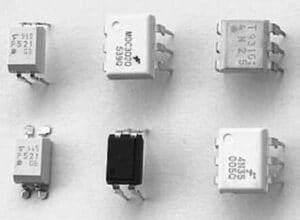
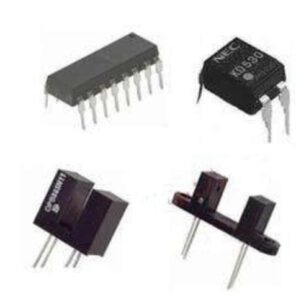
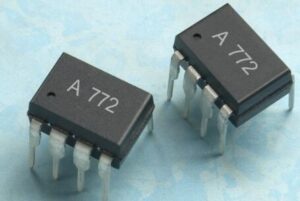
Optocoupler
An optocoupler, also known as an optical isolator or photoelectric coupler, is referred to as an optocoupler for short. It is a device that transmits electrical signals through light as the medium. Usually, a light emitter (infrared light-emitting diode LED) and a light receiver (photosensitive semiconductor tube, photoresistor) are encapsulated in the same tube shell. When an electrical signal is applied to the input end, the light emitter emits light. After the light receiver receives the light, it generates a photocurrent, which flows out from the output end, thereby realizing “electricity-optics-electricity” control.
The main advantages of optocouplers are: one-way signal transmission, complete electrical isolation between the input end and the output end, no influence of the output signal on the input end, strong anti-interference ability, stable operation, no contact, long service life, and high transmission efficiency. Optocouplers are new devices developed in the 1970s. They are now widely used in electrical insulation, level conversion, inter-stage coupling, drive circuits, switching circuits, choppers, multivibrators, signal isolation, inter-stage isolation, pulse amplifier circuits, digital instruments, long-distance signal transmission, pulse amplification, solid-state relays (SSR), instruments and meters, communication equipment and microcomputer interfaces. In monolithic switching power supplies, a linear optocoupler can be used to form an optocoupler feedback circuit. The duty cycle is changed by adjusting the control terminal current to achieve precise voltage regulation and realize signal reception and transfer.
The main characteristics of photoelectric coupling are as follows:
1. Insulation between input and output ends, whose insulation resistance is generally greater than 10000MΩ, withstand voltage can generally exceed 1kV, and some can even reach more than 10kV.
2. Since the light receiver can only receive information from the light source, but not vice versa, there will be no feedback phenomenon when the signal is transmitted unidirectionally from the light source to the light receiver, and its output signal will not affect the input end.
3. Since the light-emitting device (gallium arsenide infrared diode) is an impedance current-driven device, and noise is a high-internal-resistance microcurrent voltage signal. Therefore, the common-mode rejection ratio of the photoelectric coupling device is very large, so the photoelectric coupling device can well suppress interference and eliminate noise.
4. Easy to match with logic circuits.
5. Fast response speed. The time constant of photoelectric coupling devices is usually in the millisecond or even microsecond level.
6. No contact, long service life, small size, and impact resistance.
The main advantages of optocouplers are one-way signal transmission, complete electrical isolation between the input end and the output end, strong anti-interference ability, long service life, and high transmission efficiency. It is widely used in level conversion, signal isolation, inter-stage isolation, switching circuits, long-distance signal transmission, pulse amplification, solid-state relays (SSR), instruments and meters, communication equipment and microcomputer interfaces. Since the input impedance of the optocoupler is relatively small compared with the impedance of general interference sources, the interference voltage divided at the input end of the optocoupler is small, the current it can provide is not large, and it is not easy to make the semiconductor diode emit light; since the shell of the optocoupler is sealed, it is not affected by external light; the isolation resistance of the optocoupler is very large (about 10¹²Ω) and the isolation capacitance is very small (about several pF), so it can prevent electromagnetic interference generated by circuit coupling. The optocoupler working in linear mode adds a control voltage at the input end of the optocoupler, and proportionally generates a voltage at the output end for further controlling the circuit of the next stage. A linear optocoupler is composed of a light-emitting diode and a photosensitive triode. When the light-emitting diode is turned on and emits light, the photosensitive triode is turned on. The optocoupler is current-driven and requires a sufficiently large current to turn on the light-emitting diode. If the input signal is too small, the light-emitting diode will not be turned on, and its output signal will be distorted. In switching power supplies, especially digital switching power supplies.