
One - stop services
Spanning from electronic DESIGN to the SALE of electronic components.
Menu
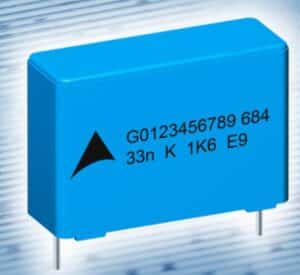
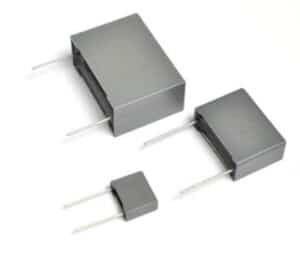
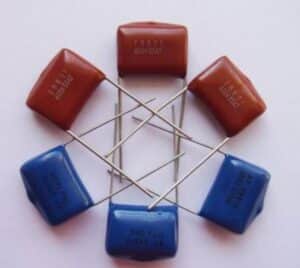
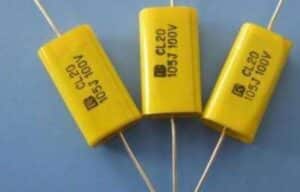
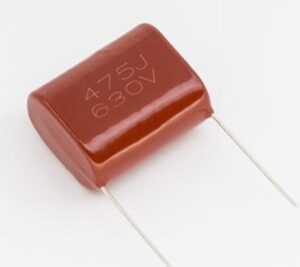
Film Capacitor
A film capacitor is a capacitor constructed by using metal foil as electrodes, stacking it with plastic films such as polyethylene terephthalate, polypropylene, polystyrene, or polycarbonate, and then winding the layers into a cylindrical shape. Depending on the type of plastic film used, they are separately named polyethylene terephthalate capacitors (also called Mylar capacitors), polypropylene capacitors (also called PP capacitors), polystyrene capacitors (also called PS capacitors), and polycarbonate capacitors.
Film capacitors are high-performance capacitors due to their many excellent characteristics. Their main properties are as follows: non-polarized, very high insulation resistance, excellent frequency characteristics (wide frequency response), and very low dielectric loss. Because of these advantages, film capacitors are widely used in analog circuits. Especially in signal interconnection applications, capacitors with good frequency characteristics and extremely low dielectric loss are required to ensure that signals are transmitted without excessive distortion.
Among all plastic film capacitors, polypropylene (PP) capacitors and polystyrene (PS) capacitors exhibit the most outstanding performance, although they are relatively more expensive. However, to improve sound quality, audio equipment increasingly uses high-grade components, and price is no longer the primary consideration. Therefore, PP capacitors and PS capacitors are being used more frequently in audio equipment.
Film capacitors are mainly applied in various industries including electronics, home appliances, communications, electric power, electrified railways, hybrid electric vehicles, wind power generation, and solar power generation. The steady development of these industries has driven the growth of the film capacitor market.