
One - stop services
Spanning from electronic DESIGN to the SALE of electronic components.
Menu
Ferrite Bead
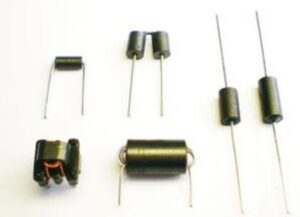
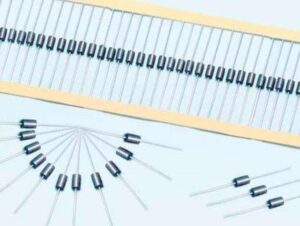
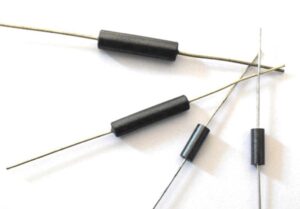
Ferrite beads are specially used to suppress high-frequency noise and spike interference on signal lines and power lines, and also have the ability to absorb electrostatic pulses.
Ferrite beads are used to absorb ultra-high-frequency signals. For example, RF circuits, PLLs, oscillator circuits, and ultra-high-frequency memory circuits (DDR SDRAM, RAMBUS, etc.) all require ferrite beads at the power input section. In contrast, an inductor is an energy storage component used in LC oscillation circuits, medium and low-frequency filter circuits, etc., whose application frequency range rarely exceeds 50 MHz. Ferrite beads have high resistivity and magnetic permeability, equivalent to a resistor and an inductor in series, but both resistance and inductance vary with frequency.
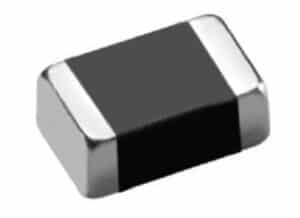
The main function of ferrite beads is to eliminate RF noise existing in transmission line structures (circuits). RF energy is an AC sine wave component superimposed on the DC transmission level, while the DC component is the required useful signal. To eliminate such unwanted signal energy, chip ferrite beads act as high-frequency resistors (attenuators).
Ferrite beads feature high resistivity and magnetic permeability, equivalent to a series combination of a resistor and an inductor, with both values varying with frequency. They offer better high-frequency filtering performance than ordinary inductors. At high frequencies, they behave resistively, thus maintaining high impedance over a wide frequency range and improving filtering efficiency.
Inductors can be used for power supply filtering. Although the circuit symbol of a ferrite bead is the same as that of an inductor, the bead can be identified by its part number. In terms of circuit function, ferrite beads and inductors share the same principle but differ in frequency characteristics.
The DC component is the useful signal required, while RF energy is unwanted electromagnetic interference (EMI) transmitted and radiated along the lines. To eliminate this unwanted signal energy, chip ferrite beads act as high-frequency resistors (attenuators), allowing DC signals to pass while filtering out AC signals. Typically, high-frequency signals are above 30 MHz; however, low-frequency signals may also be affected by chip ferrite beads. Ferrite beads have high resistivity and magnetic permeability, equivalent to a resistor and an inductor in series. In a circuit, they are simply installed by passing a wire through them. High-frequency current is dissipated as heat inside the bead. Its equivalent circuit is an inductor and a resistor in series, with both values proportional to the length of the bead. Some ferrite beads have multiple holes; passing wires through them increases impedance (proportional to the square of the number of passes).
Ferrite beads can be widely used not only in power circuits to filter high-frequency noise (for both DC and AC outputs) but also in various other circuits.
With excellent EMI suppression performance, ferrite beads are widely used in computers, VCD players, and other fields.
Ferrite beads only provide significant impedance to high-frequency signals. Common specifications are 100 Ω / 100 MHz, and their resistance at low frequencies is much lower than that of inductors.