
One - stop services
Spanning from electronic DESIGN to the SALE of electronic components.
Menu
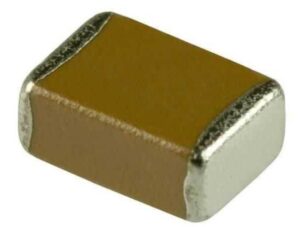
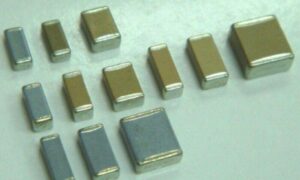
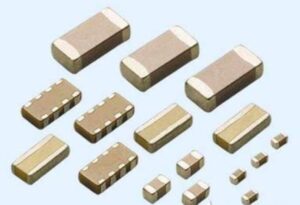
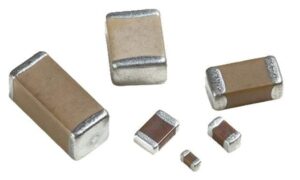
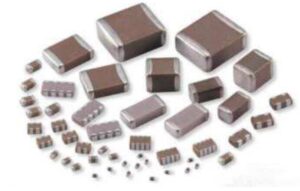
Chip Capacitor
MLCC is the English abbreviation for chip multilayer ceramic capacitors.
They are produced by stacking ceramic dielectric sheets with printed internal electrodes in a staggered arrangement, sintering them at high temperature in one step to form a ceramic chip, and then depositing metal layers (external electrodes) on both ends of the chip.
This forms a monolithic structure, so they are also called monolithic ceramic capacitors.
They are produced by stacking ceramic dielectric sheets with printed internal electrodes in a staggered arrangement, sintering them at high temperature in one step to form a ceramic chip, and then depositing metal layers (external electrodes) on both ends of the chip.
This forms a monolithic structure, so they are also called monolithic ceramic capacitors.
Based on temperature characteristics, dielectric materials and manufacturing processes, MLCCs are classified into several types: NP0, C0G, Y5V, Z5U, X7R, X5R, etc.
- NP0 and C0G: stable temperature characteristics, small capacitance, high cost
- Y5V and Z5U: large temperature variation, large capacitance, low cost
- X7R and X5R: performance between the above two categories
By package size, MLCCs are mainly available in: 3225, 3216, 2012, 1608, 1005, 0603, 0402, 0201. Larger numbers indicate wider and thicker dimensions.
For portable electronic products, MLCCs are mainly divided into two categories according to temperature characteristics: BME-based C0G series and low-ESR X7R (X5R) series.
C0G MLCCs typically have capacitance below 1000 pF. The key low-power performance index is the dissipation factor tanδ (DF).
- Traditional NME (noble metal electrode) C0G: DF = (2.0–8.0)×10⁻⁴
- Innovative BME (base metal electrode) C0G: DF = (1.0–2.5)×10⁻⁴, only 31%–50% of the NME type
These capacitors show excellent low-power performance in GSM, CDMA, cordless phones, Bluetooth, and GPS systems with T/R modules.
X7R (X5R) MLCCs mostly have capacitance above 1000 pF. Their low-power performance is mainly characterized by equivalent series resistance (ESR).
Selection Factors
- Parameters: capacitance, tolerance, voltage rating, operating temperature, dimensions
- Dielectric material
- DC bias effect
Dielectric Properties
- C0G: high temperature compensation, ideal for bypass and coupling capacitors
- X7R: temperature-stable, suitable for general industrial applications
- Z5U: small size, low cost, widely used in decoupling circuits
- Y5V: poorest temperature stability but high capacitance, can replace low-value aluminum electrolytic capacitors
Common MLCC dielectrics include C0G (NP0), X7R, Z5U, Y5V, each with distinct characteristics and applications. The main difference lies in the dielectric material. At the same volume, different dielectrics result in different capacitance, dielectric loss and stability. Therefore, the appropriate MLCC type should be selected based on its specific function in the circuit.