
One - stop services
Spanning from electronic DESIGN to the SALE of electronic components.
Menu
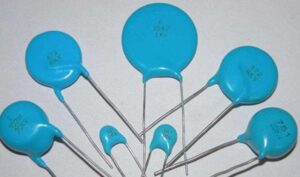
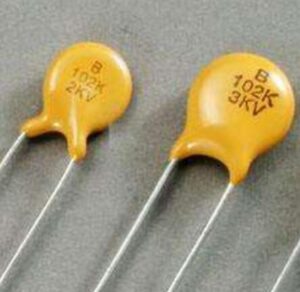
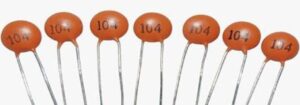
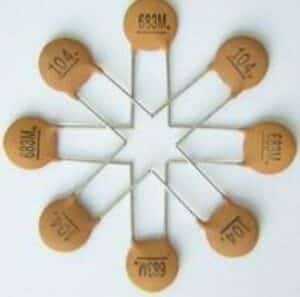
Ceramic Capacitor
Made by using capacitor ceramic with high dielectric constant (barium titanate‑titanium oxide) extruded into tubes, discs or wafers as the dielectric, and silver is fired onto the ceramic as electrodes.
They are divided into high‑frequency ceramic capacitors and low‑frequency ceramic capacitors.
They are divided into high‑frequency ceramic capacitors and low‑frequency ceramic capacitors.
Capacitors with small positive temperature coefficients of capacitance are used in highly stable oscillating circuits as tuning and padding capacitors. Low‑frequency ceramic capacitors are limited to bypassing or DC blocking in low‑frequency circuits, or in applications with low requirements for stability and loss. They are not suitable for pulse circuits because they are easily broken down by pulse voltage.
Ceramic disc capacitors are mainly designed for high frequencies. The application of high‑voltage ceramic disc capacitors depends on the scenario; their typical function is to suppress high‑frequency interference.
Advantages
- High stability of capacitance loss against temperature and frequency.
- Special series structure suitable for high‑voltage applications with long‑term reliability.
- High current slew rate and non‑inductive structure suitable for high‑current circuits.
Features
① Good heat resistance and low aging tendency due to ceramic dielectric. ② Excellent corrosion resistance to acids, alkalis and salts. ③ High dielectric constant of low‑frequency ceramic enables small size and large capacitance. ④ High insulation performance allows use in high‑voltage capacitors. ⑤ Low dependence of dissipation factor on frequency for high‑frequency ceramics, making them ideal for high‑frequency circuits. ⑥ Low cost, abundant raw materials, suitable for mass production. ⑦ Relatively small capacitance and low mechanical strength.