
One - stop services
Spanning from electronic DESIGN to the SALE of electronic components.
Menu
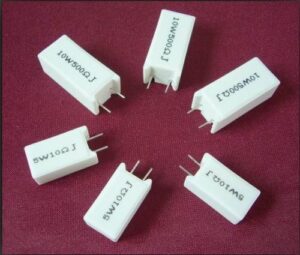
Cement Resistor
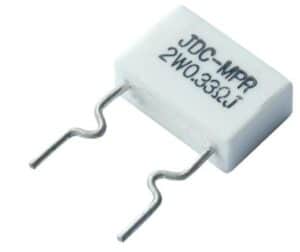
Cement Resistor: A resistor wire is wound on an alkali‑free heat‑resistant ceramic component, covered and fixed with heat‑resistant, moisture‑resistant and corrosion‑resistant materials, then placed into a square ceramic frame, and filled and sealed with special non‑flammable heat‑resistant cement. The outer shell of a cement resistor is mainly made of ceramic materials (generally classified as high‑alumina ceramic and feldspar ceramic).
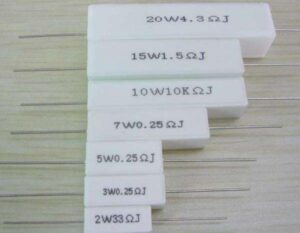
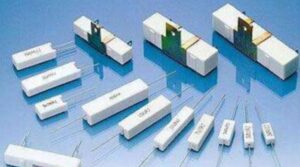
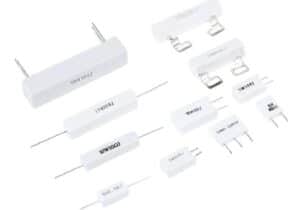
Cement resistor, as the name suggests, is a resistor encapsulated with cement (actually refractory cement, just a common name). A resistance wire is wound on an alkali‑free heat‑resistant ceramic piece, protected and fixed with heat‑resistant, moisture‑resistant and corrosion‑resistant materials, then the wire‑wound resistor body is put into a square ceramic frame and sealed with special non‑flammable heat‑resistant cement. Cement resistors fall into two categories: ordinary cement resistors and cement wire‑wound resistors. The appearance of a cement resistor is shown in the figure. As a type of wire‑wound resistor, cement resistors are high‑power components capable of carrying relatively large currents. They function the same as ordinary resistors but are suitable for high‑current applications, such as being connected in series with motors to limit their starting current, usually with low resistance values. Featuring large dimensions, shock resistance, moisture resistance, heat resistance, excellent heat dissipation and low cost, cement resistors are widely used in power adapters, audio equipment, audio frequency dividers, instruments and meters, televisions, automobiles and other devices.
Features
- Shock resistance, moisture resistance, heat resistance, excellent heat dissipation and low cost.
- Fully insulated, suitable for printed circuit boards.
- Wire wound on a ceramic rod with welded joints, enabling precise resistance values and extended service life.
- High‑resistance types are made using metal oxide film elements (MO) instead of wire winding.
- Excellent heat resistance, small temperature coefficient of resistance with linear variation.
- Withstands short‑time overloads, low noise, and stable resistance over time.
- Good explosion‑proof performance, providing protective functions.
Cement resistors are commonly used in high‑power, high‑current applications with power ratings including 2W, 3W, 5W, 10W and even higher. They are almost universally used in electrical appliances above 100 watts, such as air conditioners and televisions.
Disadvantages of cement resistors include large size, high heat generation during operation, easy heat emission, and often insufficient precision and stability for demanding applications. The shell of a cement resistor is generally made of ceramic, mainly composed of alumina (Al₂O₃), commonly known as corundum ceramic, which features fast heat dissipation and high mechanical strength.