
One - stop services
Spanning from electronic DESIGN to the SALE of electronic components.
Menu
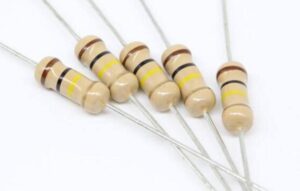
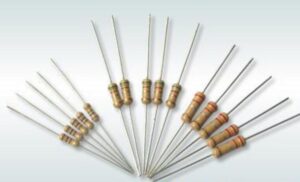
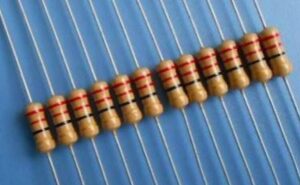
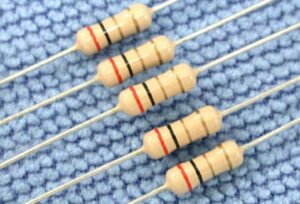
Carbon Film Resistor
Carbon film resistors are a type of film resistors. They are manufactured by adhering carbon tightly to the surface of a ceramic rod via high-temperature vacuum coating technology to form a carbon film, then adding appropriate terminals for cutting, and coating the surface with epoxy resin for sealing and protection. Their surface is usually covered with green protective paint. The thickness of the carbon film determines the resistance value, and the resistor is typically controlled by adjusting the film thickness and cutting grooves. Carbon film resistors are also referred to as “thermally decomposed carbon film resistors” — a type of thin-film resistor where carbon generated by the high-temperature thermal decomposition of hydrocarbons in a vacuum is deposited on a substrate. They feature low cost, stable performance, and a wide range of resistance and power ratings.
Carbon film resistors can also be made by mixing carbon ink, graphite, and fillers into a suspension with an organic binder, coating it on an insulating substrate, and then heating it for polymerization. In addition, gaseous hydrocarbons decompose at high temperatures in a vacuum, and carbon is deposited on a ceramic rod or tube to form a crystalline carbon film. Different resistance values can be obtained by changing the thickness of the carbon film and adjusting the length of the carbon film through grooving. Carbon film resistors have low cost but relatively poor electrical performance and stability, so they are generally not suitable for general-purpose resistors. However, since they can be easily made into high-resistance films, they are mainly used as high-resistance and high-voltage resistors, with applications the same as those of high-voltage resistors.
The lead connection methods of carbon film resistors include axial leads, ribbon leads, and leadless types.
The resistance range of carbon film resistors is 1Ω~10MΩ (generally 2.1Ω~10MΩ for precision models). The rated power includes 1/8W (0.125W), 1/4W (0.25W), 1/2W (0.5W), 1W, 2W, 5W, 10W, etc.
Their main function is to impede current flow. They are applied in current limiting, current shunting, voltage reduction, voltage division, acting as loads to match capacitors for filtering, and impedance matching, etc.
Characteristics
1. Accuracy: 2%, 5%; high precision. The resistance value can be adjusted by cutting threads on the film to produce precision resistors.
2. Resistance range: Wide, generally 2.1Ω~10MΩ (the overall range is 1Ω~10MΩ).
3. Nominal resistance: E-48.
4. High limit voltage.
5. Excellent long-term stability; the impact of voltage changes on resistance is minimal, and it has a negative temperature coefficient.
6. Packaging methods: Tape packaging and bulk packaging.
7. Good high-frequency characteristics; can be made into high-frequency and ultra-high-frequency resistors; inherent noise electromotive force is small, below 10μV/V.
8. Rated power: 1/8W, 1/4W, 1/2W, 1W, 2W, 5W, 10W (consistent with the above specifications).
9. Stable pulse load and good adaptability to pulses. It has a very wide application range and is suitable for AC, DC, and pulse circuits.